Clinical + market trends
Does the 2026 Malaysia ACS guideline meaningfully expand post-ACS cardiometabolic therapy?
Posted on 3 July 2026 7 mins read

The 2026 Malaysian Clinical Practice Guidelines for acute coronary syndrome place newer cardiometabolic agents more visibly within secondary prevention tables, including semaglutide and sodium-glucose cotransporter 2 inhibitors. For specialists, the real issue is not whether these drugs have cardiovascular value in broader populations, but how far that evidence can be translated into post-acute coronary syndrome care when syndrome-specific proof remains uneven.
Guideline shift: from ACS-only care to cardiometabolic secondary prevention
The Ministry of Health Malaysia 2026 Clinical Practice Guidelines for acute coronary syndrome (ACS) appear to move beyond a purely antithrombotic and anti-ischaemic frame by listing dapagliflozin, empagliflozin, and semaglutide in medication tables with practical dosing detail. In the same guideline-linked source summary, dapagliflozin is presented as initiable at estimated glomerular filtration rate (eGFR) at least 25 mL/min/1.73 m², empagliflozin at eGFR at least 20 mL/min/1.73 m², and semaglutide with weekly escalation from 0.25 mg to 0.5 mg, up to 2.0 mg weekly. That matters because it operationalises these agents for specialist practice rather than leaving them as generic diabetes add-ons.
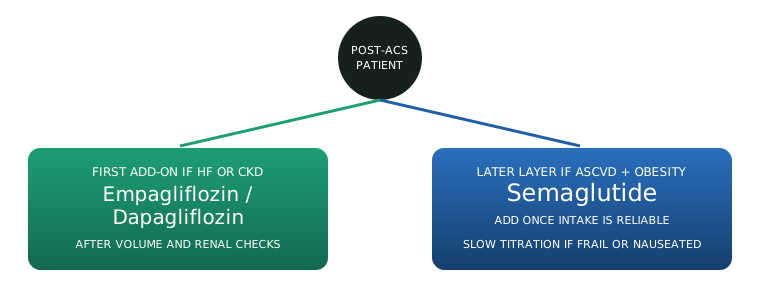
Yet inclusion in an ACS guideline does not itself create direct post-ACS efficacy evidence. Across the current literature, evidence synthesis indicates that foundational post-ACS therapy still begins with high-intensity statin therapy, dual antiplatelet therapy (DAPT), beta-blocker therapy where indicated, and renin-angiotensin system blockade, with cardiometabolic drugs layered after haemodynamic, renal, and nutritional stability are established.
What the evidence supports and where ACS-specific proof remains limited
The most direct randomised evidence supplied here for semaglutide is SELECT, in which semaglutide 2.4 mg once weekly reduced major adverse cardiovascular events in patients with overweight or obesity and established cardiovascular disease, without diabetes. In that trial, the primary composite of cardiovascular death, non-fatal myocardial infarction, or non-fatal stroke was reduced over a mean follow-up of 39.8 months. This broadens the conversation beyond glucose lowering and gives semaglutide a secondary prevention signal in an ASCVD-obesity phenotype.
SELECT
Trial · primary endpoint
0.80
Hazard ratio for MACE, semaglutide
39.8 mo
Mean follow-up
However, the supplied ACS-specific sources do not show a semaglutide trial conducted specifically in the immediate post-ACS setting. The extrapolation is therefore phenotype-based rather than syndrome-proven. By contrast, evidence synthesis indicates that SGLT2 inhibitors are more strongly anchored in heart failure and CKD benefit than in prevention of recurrent coronary thrombosis after ACS. That difference in evidentiary centre of gravity is important, because guideline visibility can run ahead of direct syndrome-specific trial certainty.
A second source-reconciliation issue is renal thresholding. Evidence synthesis cites glucose-lowering label thresholds of eGFR at least 30 mL/min/1.73 m² for empagliflozin and at least 45 mL/min/1.73 m² for dapagliflozin, while more recent CKD guidance and the Malaysian ACS source summary support cardiorenal use to lower thresholds, down to at least 20 for empagliflozin and at least 25 for dapagliflozin in the local ACS table. Source discrepancy note: the Malaysian ACS source summary cites dapagliflozin initiation from eGFR at least 25, whereas the Dx evidence synthesis summarises broader CKD guidance as supporting initiation for cardiorenal protection down to eGFR at least 20 for both agents, confirm against the primary local table before fixing institutional protocols.
Phenotyping residual risk after ACS
If these drugs are to be used intelligently after ACS, the key measurement task is residual-risk phenotyping. The supplied sources repeatedly centre five variables: body mass index (BMI), eGFR, heart failure status, glycaemic context, and current clinical stability. Semaglutide becomes most persuasive when established ASCVD coexists with overweight or obesity, particularly a SELECT-like phenotype with BMI at least 27 kg/m². SGLT2 inhibitors move forward when heart failure, CKD, congestion risk, or albuminuric cardiorenal vulnerability dominate the post-ACS picture.
| Phenotype signal | Agent more strongly supported | Practical constraint |
|---|---|---|
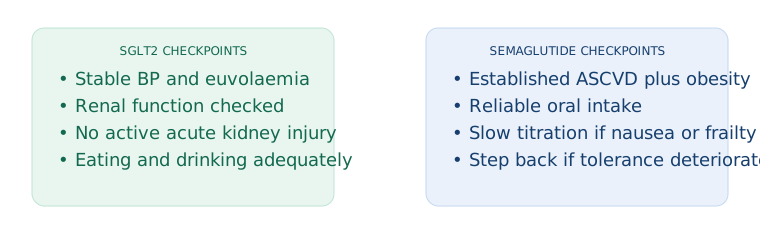
| HF, congestion risk, CKD progression risk | Empagliflozin or dapagliflozin | Check eGFR, volume status, acute kidney injury history, oral intake |
| ASCVD with overweight or obesity, residual metabolic risk | Semaglutide | Delay or slow titration if nausea, poor intake, frailty, dehydration risk |
Why cardiometabolic risk persists after plaque destabilisation
The pathophysiological rationale for earlier cardiometabolic treatment after plaque destabilisation is coherent, even when post-ACS trial proof is incomplete. The supplied sources support a phenotype in which obesity, insulin resistance, endothelial dysfunction, inflammation, and cardiorenal coupling sustain residual risk after the index event. Semaglutide therefore aligns best with patients whose ongoing hazard is strongly metabolic and adiposity-driven, while SGLT2 inhibitors align more closely with heart failure biology, renal vulnerability, natriuretic needs, and congestion-prone trajectories.
Practical sequencing of SGLT2 inhibitors and semaglutide after ACS
For specialists in Malaysia, the most defensible sequence remains to secure the evidence core first: high-intensity statin, DAPT, beta-blocker where indicated, and renin-angiotensin system blockade, alongside rehabilitation and risk-factor control. If heart failure or CKD is present, empagliflozin or dapagliflozin generally comes next once the patient is haemodynamically stable, volume depletion has been corrected, oral intake is adequate, and renal function is acceptable for the intended indication. Practical safety checks include serum creatinine, eGFR, electrolytes, blood pressure, volume status, recent acute kidney injury, loop diuretic burden, and sick-day counselling about temporary interruption during acute illness, dehydration, vomiting, diarrhoea, fasting, or procedures.
Semaglutide should usually be layered later, after early stabilisation, in patients with established ASCVD plus overweight or obesity, especially where residual metabolic risk remains high despite standard therapy. The standard weekly escalation schedule is 0.25 mg, then 0.5 mg, then 1.0 mg, then 1.7 mg, then 2.4 mg in the supplied label-based evidence synthesis, while the Malaysian ACS source summary lists escalation from 0.25 mg to 0.5 mg and up to 2.0 mg weekly, again confirming that local table wording should be checked directly before protocolisation. If nausea, poor intake, dehydration risk, or frailty is present, escalation should be delayed, the last tolerated dose maintained longer, or the dose stepped back temporarily rather than forced upward by calendar alone.
FUKKM relevance should not be overstated: the Ministry of Health Malaysia formulary framework is a practical access reference, but the supplied sources do not establish specific reimbursement, restriction, or uptake pathways for these agents in every Klinik Kesihatan or Hospital (MOH) setting.